| Locking and Prevailing Torque Guide Specialty Bolt and Screw, Inc. specialtybolt.com |
Locking and Prevailing Torque Guide
This tool is currently in beta. While the torque performance data is sourced directly from IFI standards (124, 125, 524 & 525), some features and formatting are still being refined before the official release.
We invite you to explore the tool and use it as a reference for thread locking mechanism selection. Your feedback is valuable — if you notice any issues or have suggestions, please share them with our team.
Thank you for being an early user. We hope this guide makes specifying the right locking solution faster and easier.
| Locking and Prevailing Torque Guide Specialty Bolt and Screw, Inc. specialtybolt.com |
Pre-Applied, Adhesive Coated, Non-Metallic Resistant | Thread locking mechanism selection and torque performance data per IFI standards (124, 125, 524 & 525)
No results found
Adjust your filters or search termsMeasurement System↕ |
Thread Size↕ |
Locking Mechanism↕ |
Standard |
Locking Performance |
Patch Diagram |
Patch Location Notes |
|---|
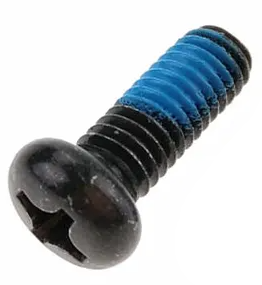
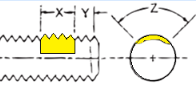
A nylon insert, patch, or pellet is factory-applied to a portion of the thread. During assembly the nylon deforms under compression and creates a mechanical interference fit on the thread directly opposite the patch. This asymmetric friction resists loosening without any chemical bonding. The locking zone is localized to approximately 120 degrees of arc.
IFI-524 (Metric) and IFI-124 (Inch) both specify minimum prevailing-off torque values after 5 removal cycles. Torque typically drops 30 to 50 percent from first to fifth removal. Most manufacturers recommend replacing after 5 to 10 removals depending on application criticality.
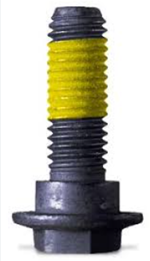
Microencapsulated adhesive beads are factory-applied around the full 360-degree thread circumference. During assembly, fastener engagement ruptures the microcapsules, releasing adhesive that chemically bonds to both mating thread surfaces as it cures. Locking is chemical adhesion, not friction. The 360-degree coverage provides uniform locking force across the entire thread contact area.
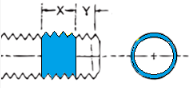
Preapplied adhesive is a single-use system. Once microcapsules are ruptured and adhesive cures, reassembly without reapplication provides only residual friction. For applications requiring multiple removals, nylon patch is the preferred choice.
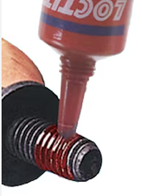
Anaerobic liquid adhesive is applied by the assembler directly to fastener threads immediately before installation. In the absence of air and presence of metal ions, the liquid undergoes anaerobic polymerization, forming a rigid thermoset plastic that fills thread voids and chemically locks both surfaces. Unlike factory-applied systems, the assembler controls grade and quantity at point of use.
Low strength (Blue 242): Removable with hand tools. Ideal for set screws, adjustment fasteners, and frequently serviced joints.
High strength (Red 271): Permanent hold; requires heat (approx. 450 deg F) or special tooling for removal. Use only where disassembly is not anticipated.
| Attribute | Nylon Patch (NYLOK) | Preapplied Adhesive | Applied Liquid Locker |
|---|---|---|---|
| Locking Method | Mechanical interference (friction) | Chemical adhesion (encapsulated) | Chemical adhesion (anaerobic cure) |
| Where Friction Acts | Thread opposite the patch location | Full 360-deg chemical bond on all threads | Full thread fill; rigid thermoset bond |
| Applied By | Fastener manufacturer | Fastener manufacturer | Assembler at point of use |
| Lock Time | Immediate on assembly | Short cure time required | Hours; grade and temperature dependent |
| Prevailing-On Torque | Moderate (from first turn) | Moderate | Near zero during installation |
| Reusability | Yes (torque degrades per cycle) | No (single use only) | No (re-apply required) |
| Vibration Resistance | Good | Very Good | Excellent |
| Sealing Ability | None | Limited | Yes (fills voids, resists corrosion) |
| Process Control Risk | Low (factory applied) | Low (factory applied) | Higher (assembler dependent) |
| Temperature Limit (typical) | Up to 250 deg F | Up to 300 deg F | Up to 300+ deg F (grade dependent) |
| IFI Standard (Metric) | IFI-524 | IFI-525 | IFI-525 |
| IFI Standard (Inch) | IFI-124 | IFI-125 | IFI-125 |
Disassembly and reassembly is needed. Maintenance access is required. No liquid application available at the assembly station. Simple drop-in fastener solution preferred. Measurable prevailing torque from the first installation turn is required.
Higher vibration resistance than nylon is required but assembly must stay clean and simple. No liquid application at the line. Joint is unlikely to require disassembly. Consistent torque performance across the production lot is critical.
Maximum locking strength or joint sealing is required. Grade must be selected at point of use. Passive surfaces require activator. Engineer specifies permanent hold (Red 271) or serviceable (Blue 242) based on service life and maintenance requirements.
Disclaimer: This tool is for reference and specification guidance only. Torque values are per IFI standards as indicated. Actual performance may vary based on materials, coatings, and application conditions. Always consult the applicable IFI standard and a qualified engineer for critical applications. Specialty Bolt and Screw, Inc. assumes no liability for specification errors or misapplication of this data.